The Damascus Gold Souk: What to Know Before You Buy
4 September 2026
You have landed in Damascus after years away, carrying one assignment from your mother: bracelets for your cousin, whose wedding is next month. Now you stand at the entrance to Harika. Yellow shopfronts stretch in every direction, and all of them glitter equally. Where do you start?
This is the practical answer. The souk's long history - the Ayyubid-era covered market by the Umayyad Mosque, the two fires that moved the trade to its current home - is told in full in our Arabic companion piece on Souk al-Sagha's history. Here we talk about buying.
Finding it
The beating heart is the Harika district inside the Old City, wedged between Souk al-Hamidiyah and Midhat Pasha street, minutes from the Umayyad Mosque. Dozens of shops sit side by side, with workshops tucked into upper floors and back alleys. Respectable gold shops also operate in Salihiyah, Shaalan, and Midan, but Harika is the reference point. It has the widest selection, and it is where the market's customs are set.
Rule one: know the bulletin before you go
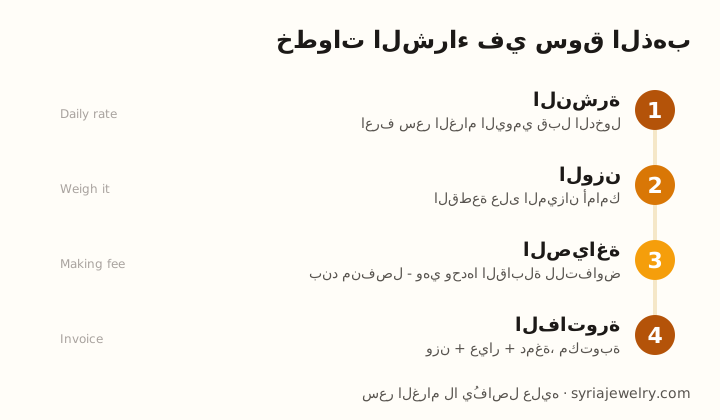
Every morning the Damascus goldsmiths' association publishes a bulletin fixing the gram price for each karat, and virtually the whole market follows it. This is genuinely comforting for a visitor. The gram price is not up for haggling, which means nobody can cheat you on the raw gold itself. The number is public and uniform.
Before you walk in, open the live price board and memorize two figures: the 21k gram and the 24k gram. With those two numbers you can estimate the value of any piece in any window within seconds. Goldsmiths treat customers differently once they sense you know the day's rate.
One warning for the long-absent. Prices are now quoted in new Syrian pounds, each worth one hundred of the old. The numbers will sound far smaller than the ones in your memory. That is redenomination, not a discount.
Rule two: everything gets weighed in front of you
Damascus prices gold one way only. The piece goes on the scale in front of you, the weight is multiplied by the bulletin price for its karat, and the making fee is added as a separate, named line. Three visible numbers: weight, gram price, workmanship.
If someone quotes you a single lump sum with no weight and no breakdown, ask politely for the breakdown. If he hesitates, the next shop is two steps away. Comparing prices across three neighboring shops is an old Damascene habit and offends no one.
Rule three: negotiate the making fee, nothing else
This is where most visitors go wrong. They either haggle over the total price, which marks them as outsiders, or they feel awkward negotiating at all and overpay. The correct path runs between the two. The gram price is untouchable; the making fee is where generosity lives. It varies by shop and by piece - handworked and stone-set pieces carry higher fees than plain bangles - and there is real room to talk, especially when buying a full set. We break down typical fee ranges in our making-fees guide.
A field-tested tip: ask "how much is the workmanship per gram?" before asking for the total. The question itself tells the goldsmith you know how this market works.
The invoice and the hallmark
Recent market regulations tightened invoicing rules, which works entirely in your favor. A proper invoice states the weight, the karat, the day's gram price, and the making fee. The hallmark stamped on the piece itself - usually 875 for 21k - is its passport for resale anywhere in Syria. A piece without a clear hallmark gets tested before you pay, however friendly the seller. Testing methods are covered in our fake-gold guide.
Shopping for a bridal set? Keep the mahr estimator open on your phone. It gives you a realistic cost for a full shabka at today's prices before you promise anything to the bride's family.
Damascus versus Dubai and Istanbul
A visitor arriving from the Gulf walks into Harika with Dubai's Gold Souk in mind. The differences are worth knowing.
First, the karat. Gulf markets split between 22k, 21k, and 18k; Turkey leans to 22k and 14k. Damascus trades in 21k, full stop. It is what brides receive and what any Syrian goldsmith will later buy back from you without hesitation.
Second, tax. Damascus adds no Gulf-style VAT to your purchase, while several Gulf states tax the making fee or the piece, with tourist-refund schemes that vary by country.
Third, the mood. Dubai's souk is built for tourists: vast displays, near-fixed prices, English everywhere. Harika is built for locals: relationships, tea, shops inherited from father to son. If tea is offered, drink it at your ease. Sitting down commits you to nothing.
Fourth, resale. Gold bought in Damascus with a Syrian hallmark sells in Homs, Aleppo, or Latakia at the bulletin price minus a small margin. Gold bought abroad in another karat may be valued here as scrap, at a lower rate.
Five minutes before you walk in
Check the bulletin on your phone. Set your budget in grams, not pounds - grams hold still while prices move. Decide your karat in advance; if you are torn, the karat guide settles it in five minutes. And keep the gold converter handy to price any weight at any karat while standing at the window.
Then walk in with confidence. A market that has served Damascenes for eight centuries knows how to serve you too, provided you enter on its golden rule: the gram at the bulletin price, and all the conversation in the making fee.
FAQ
Where exactly is the Damascus gold souk?
The trading heart today is the Harika district inside the Old City, between Souk al-Hamidiyah and Midhat Pasha street, a few minutes on foot from the Umayyad Mosque. The historic name Souk al-Sagha refers to the older goldsmiths' market that stood near the mosque's southern gate before fire pushed the trade into Harika.
Can I pay in dollars at the gold souk?
Official pricing is in new Syrian pounds, set by the goldsmiths' association bulletin each morning. Many shops accept dollars and convert at the day's rate. Ask which exchange rate the shop uses before paying, and compare it with the market rate so the spread does not quietly inflate your bill.
Is buying gold in Damascus cheaper than in Dubai or Istanbul?
The gram price tracks the global spot price everywhere, so the real difference sits in making fees and taxes. Damascus is usually cheaper on workmanship for traditional 21k pieces and adds no Gulf-style VAT. Factor in export limits at the airport if you plan to fly out with your purchase.