Syrian Jewelry: Five Thousand Years from Ebla to the Damascus Souk
4 September 2026
In the Aleppo museum sits a small gold necklace from the royal tombs of Ebla. It is more than four thousand years old. Look at it closely, then look at the bangles on any Syrian bride today. The craft is the same one, and the distance between the two pieces is not a rupture but a single gold thread stretched across the centuries. This article walks that thread, stop by stop.
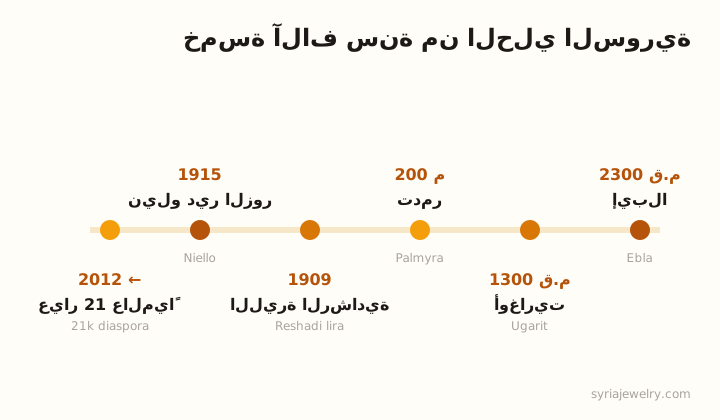
Ebla, Ugarit, Mari: the very early start
In the third millennium BC, the kingdoms of inland and coastal Syria were already working gold with techniques still taught today. Ebla's royal tombs yielded necklaces and medallions decorated with filigree and granulation - twisted gold wire and microscopic soldered spheres. At Ugarit on the coast, where the alphabet was born, excavators found crescent earrings and a star pendant from the fourteenth century BC: a central star inside a cosmic frame of hammered dots. Hammering was the mother technique; ornamenting the hammered surface was an art the kingdoms competed in.
The point matters more than the beauty. Goldsmithing here was not an import from some neighboring civilization. It was a mature local industry, with workshops and traditions, before Rome existed or Athens was built.
Palmyra: where more gold meant more honor
Jump eighteen centuries forward. Palmyra in the second century AD is a rich caravan city linking Persia and India to the Mediterranean, and its merchant families memorialize their dead with portrait busts sealing the burial slots of tower tombs. Those busts are the most precious fashion record in ancient Syrian history.
In Rome, a virtuous woman was portrayed with little jewelry, as a sign of modesty. Palmyra inverted the rule: the more jewelry, the more honorable the lady. Palmyrene women were carved wearing as many as seven necklaces on one chest, each of a different design, along with diadems, earrings, bracelets, and rings. Recent research shows the busts were painted, their carved jewelry covered in real gold leaf and inlaid with colored glass. Stone wearing gold - that is how Palmyra honored its women.
The Ottomans: the coin becomes jewelry
The next leap is long. It passes the gold of Umayyad and Ayyubid courts and the covered markets of the Mamluks - among them the Damascus Souk al-Sagha, still alive - and arrives at an Ottoman phenomenon that shapes Syrian jewelry to this day: the wearable gold coin.
The Ottoman lira - most beloved in Syria in its Reshadi form, struck in the name of Sultan Mehmed V Reshad after 1909 at 7.2 grams of 22k gold - did not stay in pockets. It moved onto chests. Coins were pierced or fitted with soldered loops, strung into necklaces and breast chains, sewn onto headdresses. A woman's coins were her bank, worn in public: her own declared wealth, from which she detached a lira in hard times and to which she added one in good ones. The full story of the Reshadi, with prices and counterfeit checks, is in our Reshadi lira guide.
Damascus, Aleppo, and the niello of the Euphrates
Beneath the Ottoman surface, the local schools matured into the ones we know: Damascus with its hand engraving and heavy classical pieces, Aleppo with its fine, precise work, enriched by Armenian craftsmen arriving from Cilicia after the massacres of 1915. With the Armenians came niello - a black mixture of metal sulfides fused into engraved channels, leaving glossy dark designs on white silver. The technique found its second home in Deir ez-Zor, and "Deiri silver" became the signature of the Euphrates.
These three schools have a full article of their own: Syrian goldsmithing and its schools. One line places them in the five-thousand-year frame: the granulation soldered by Ebla's goldsmiths is the same granulation in fine Aleppine work. The tools improved. The hand is the same hand.
After 2011: the craft scatters but does not die
Then the war did to goldsmithing what it did to everything else. Workshops closed and craftsmen emigrated by the thousands - guild estimates put around five thousand Syrian goldsmiths in Gulf and Egyptian workshops alone - while Aleppines and Damascenes opened shops in Istanbul and Gaziantep. And something unexpected happened. Instead of dissolving into its new markets, the migrating craft imposed its taste on them. Turkish goldsmiths did not know 21 karat before the Syrians arrived; the newcomers introduced it to the Fatih district, until Turkish customers began asking for "Syrian gold" by name.
Why 21k is the end of the story
The whole thread we have walked ends at one number. Twenty-one karat - gold at 87.5 percent purity - is the Syrian signature because it condenses five thousand years of philosophy: jewelry here is ornament and treasury at once. Its yellow is rich enough for a wedding, its hardness survives daily wear, and its value sits close to raw gold, so the owner recovers her money when she needs it - exactly as the Palmyrene lady wore her fortune and the grandmother unclipped a lira from her necklace. For the numbers, compare karats in the karat guide; for today's rate, see the live price board.
The necklace in the Aleppo museum does not know it started all this. But every bangle worn at a Syrian wedding tonight, from Damascus to Berlin, finishes its sentence.
FAQ
What is the oldest known Syrian jewelry?
Among the oldest documented pieces are the finds from Ebla's royal tombs, including a famous gold necklace now in the Aleppo museum, dating to around the third millennium BC. Ebla and Ugarit pieces already show filigree and granulation, techniques Syrian goldsmiths still use today.
Why do Palmyra's funerary busts show women covered in jewelry?
Because Palmyrene custom was the reverse of Roman custom. In Rome, modest jewelry signaled feminine virtue; in Palmyra, more jewelry meant more honor. Women were carved wearing up to seven different necklaces at once, plus diadems, earrings, and bracelets, and the carvings were originally gilded and inlaid with colored glass.
Why is Syrian gold 21 karat?
The Syrian market settled on 21k (87.5 percent pure) because it balances a rich yellow color, everyday durability, and a resale value close to raw gold - jewelry as both ornament and savings. Syrian goldsmiths displaced after 2011 carried the standard abroad, introducing 21k to markets like Istanbul that had never traded it.